
As a long-time player of the Assassin's Creed series, I've come to a realization in 2026: the formula, especially regarding its iconic Synchronization Points, has grown profoundly stale. Ubisoft's attempts to tweak the mechanic, most recently in Assassin's Creed Shadows, feel like minor adjustments to a system that fundamentally needs reimagining. While I admire the desire for innovation, the current implementation often feels like a step sideways rather than forward, leaving me questioning the very purpose of these once-majestic climbs. Isn't it time we moved beyond simply climbing a tower to reveal a checklist?
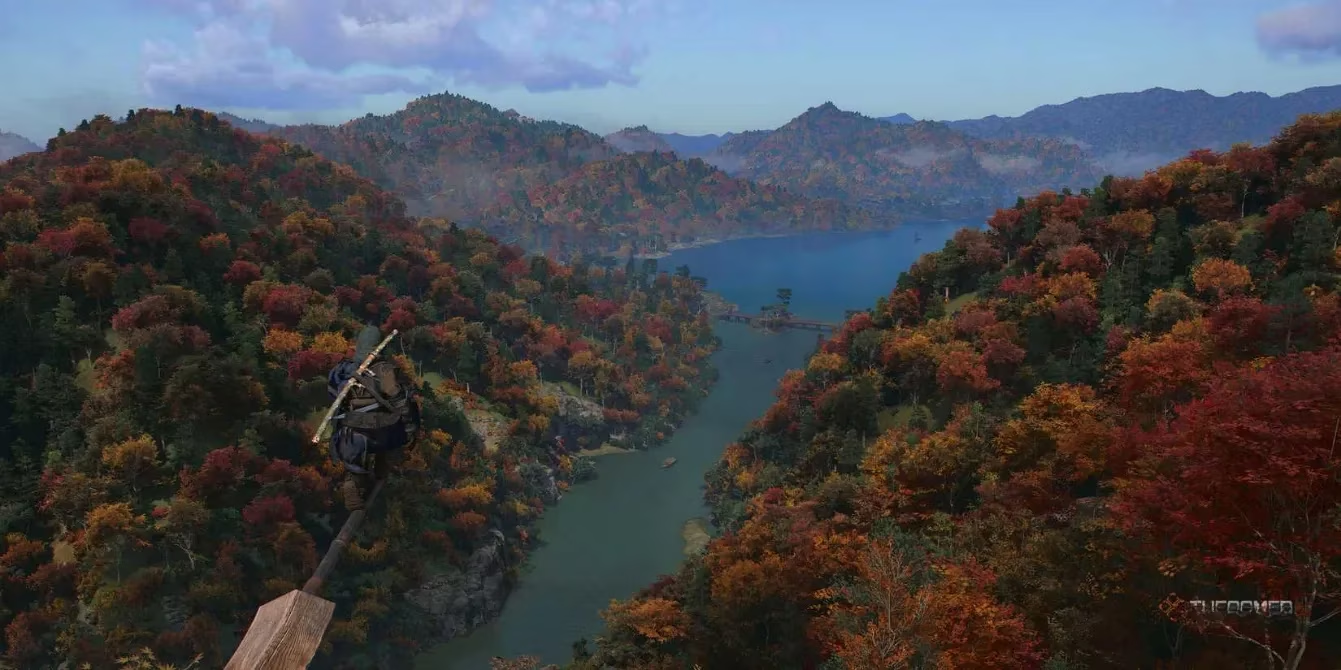
Let's talk about the specific problem with Assassin's Creed Shadows. The game changed the classic formula in a seemingly small way. Instead of climbing a tall structure, enjoying that breathtaking panoramic view, and having my map populated with specific icons for activities, I now see... question marks. A handful of mysterious, identical question marks scattered across the revealed area. On paper, Ubisoft's intention is clear: to instill a greater sense of discovery. But in practice, what does this actually achieve?
For me, it creates frustration, not wonder. I climb this magnificent pagoda, soak in the beauty of feudal Japan, and then my reward is ambiguity. Is that question mark a shrine offering a valuable Knowledge Point? Is it a hidden tale? Or is it, as I've found all too often, just a small, featureless village with nothing of interest? I have no idea until I trek all the way there. This doesn't make the world feel more mysterious; it makes it feel disorganized and, frankly, disrespectful of my time. If the core gameplay loop is about planning my approach as an assassin or a samurai, how can I plan when I don't know what I'm approaching? The change feels misguided, shrouding basic side content in unnecessary mystery while the game's more substantial quests are signposted elsewhere.
This issue points to a larger, systemic fatigue. The act of "climb tall thing, reveal map" has become a tired trope not just in Assassin's Creed, but in open-world gaming as a whole. It's a mechanic that belongs to an era we're actively moving past. We've been doing this for nearly two decades! The view from the top is always stunning—I'll never deny that—but the mechanical payoff has become rote. It simply extends a to-do list. When I look at a map full of those Shadows-style question marks and discover that most lead to empty spaces, I don't feel like an explorer; I feel like a completionist hamster on a wheel.
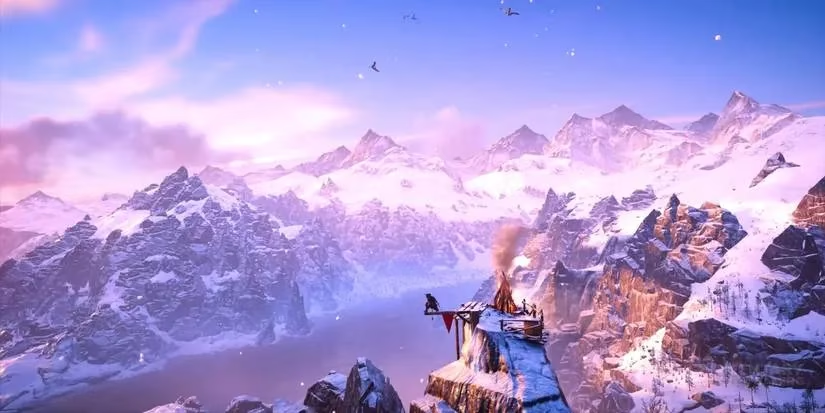
So, where do we go from here? If Ubisoft is serious about refreshing the parts of the formula that have grown old, Synchronization Points are the perfect place to start. My ideas for a fix come in two interconnected parts: redefining their core purpose and revolutionizing how we gain map knowledge.
First, let's give Synchronization Points a true mechanical heart.
Why must the primary reward be map data? What if the climb itself was directly tied to my character's growth? Imagine these points serving a central progression function. For instance:
-
Climbing a major Synchronization Point for the first time could be the only way to unlock a new branch of your skill tree, representing a moment of clarity and new understanding high above the world.
-
Perhaps reaching the peak allows you to permanently attune your Hidden Blade or weapon, granting it a unique, location-based perk.
-
It could be a moment of spiritual or synchronization alignment that grants a permanent stat boost or unlocks a core ability.
The incentive shifts from "I need to check this off to see stuff" to "I need to conquer this challenge to become stronger." The reward is gameplay depth, not just map completion.
Second, we need a more engaging and intelligent way to learn about the world. The current binary choice—either revealing everything or revealing vague question marks—isn't working. Here are some alternatives I've been pondering:
| Proposed System | How It Works | Player Engagement |
|---|---|---|
| The Cartographer's Craft 🗺️ | Question marks appear when you're near a region, but to decipher them, you must seek out cartographers in towns, who trade map details for resources or completed tasks. | Encourages interaction with NPCs and makes world knowledge a earned commodity. |
| Environmental Storytelling 🌲 | Drop icons altogether. Use visual cues, overheard conversations, found notes, and animal behavior (like the foxes in Ghost of Tsushima) to guide players to points of interest. | Makes exploration organic and rewards player observation and curiosity. |
| Progressive Intel 🔍 | Synchronization Points give a vague, high-level overview (e.g., "this valley has many bandit camps"), but specific locations are only filled in by scouting from lower vantage points, eavesdropping, or interrogating enemies. | Makes information gathering an active part of the stealth/assassin fantasy. |
| Faction-Based Revelation ⚔️ | Aligning with or infiltrating different factions (merchants, rebels, government) gradually reveals specific types of points of interest relevant to that faction on your map. | Ties map knowledge directly to your role-playing choices and alliances. |
I'm not a game designer at Ubisoft. I'm sure the teams have experimented with countless ideas, and the current system likely works efficiently for their large-scale production. But as a dedicated player, the fatigue is real. The magic of that first synchronized leap from a viewpoint in 2007 is gone, replaced by a sense of obligation. The view from the top of a pagoda in Shadows is breathtaking, a true technical marvel. But when that awe fades and I'm left staring at a map of cryptic symbols promising mostly trivial content, the whole ritual feels hollow. It's 2026. We're in an era of dynamic worlds and deep systemic gameplay. Our methods for exploring and understanding those worlds should evolve too. It's time for Synchronization Points to synchronize with the future of gaming, not its past.