
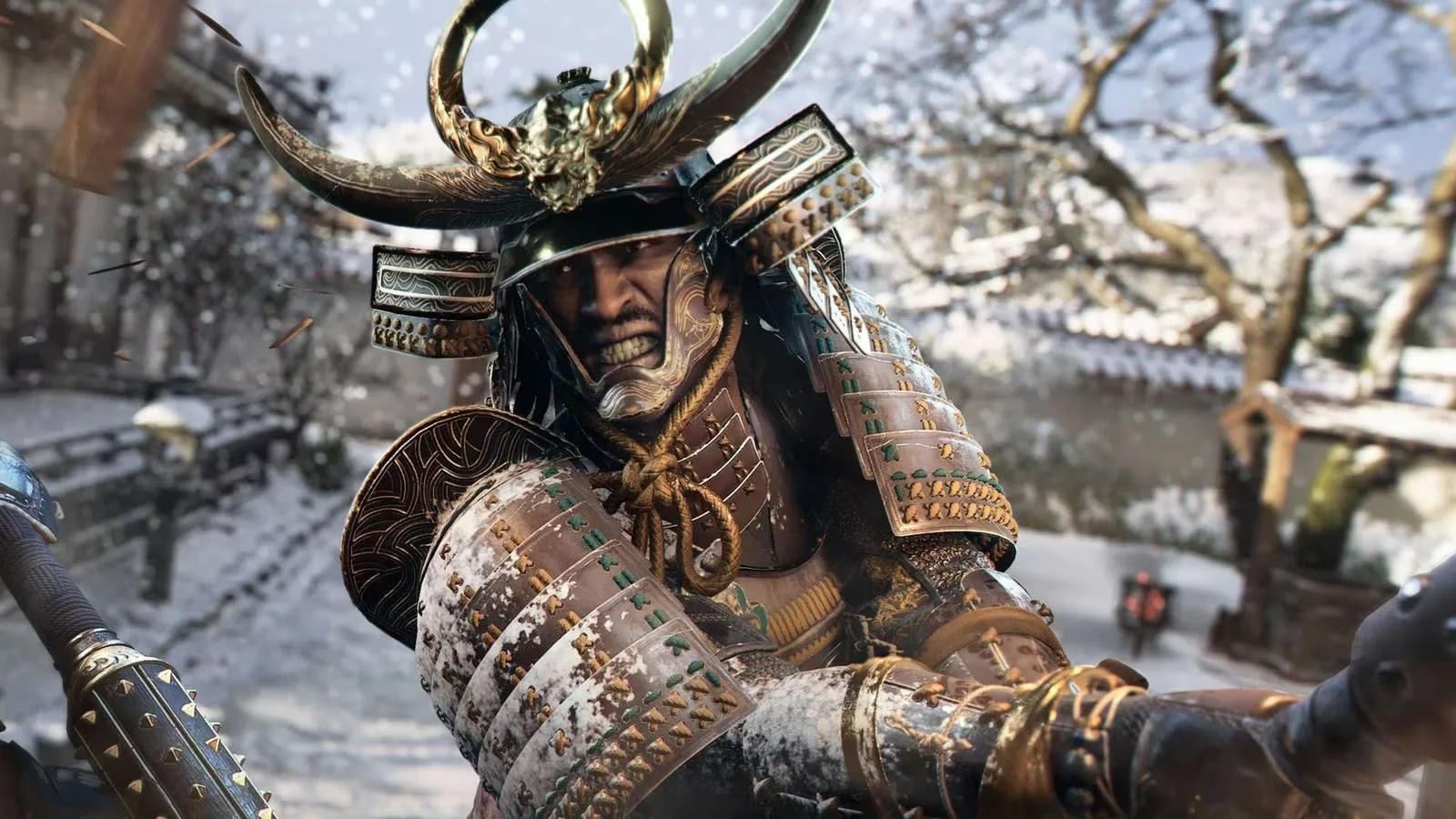
The hallowed digital landscapes of feudal Japan in Assassin's Creed Shadows have become the latest battleground, not for its protagonists Naoe and Yasuke, but for its very player base! A seismic shift is rumbling through the community, triggered by Ubisoft's announcement of a colossal quality-of-life update that promises to utterly revolutionize how players navigate the game's sprawling world. This isn't just a tweak; it's a tectonic plate movement in game design philosophy, pitting the purist pioneers against the champions of convenience in a debate that echoes through the annals of gaming history. The core of this uproar? A planned change to the sacred act of map revelation, transforming a methodical, inch-by-inch conquest of the unknown into a grand, sweeping unveiling of the realm.
🔥 The Great Unfogging Controversy: What's Changing?
For months, players have traversed the misty mountains and hidden valleys of Shadows under a very specific rule: the map only revealed itself in a modest, intimate radius around the player character. To know the land, you had to walk the land. Every forest path, every remote village, every cliffside shrine demanded a personal pilgrimage. This was the covenant between player and world. Now, Ubisoft intends to shatter that covenant with an update slated for late July. The new system will see synchronization points—those lofty vantage points—acting not as modest beacons, but as cartographic supernovas, instantly "unfogging" vast, generous portions of the surrounding map in one glorious, illuminating burst.
The Old Way vs. The New Way:
| Aspect | Before the Update (The Purist's Path) | After the Update (The Tourist's Tour) |
|---|---|---|
| Map Revelation | Slow, personal, radius-based exploration. | Instant, massive unveiling from sync points. |
| Player Effort | Extremely high; required visiting every nook. | Drastically reduced; rewards vantage points. |
| Exploration Feel | Intimate, discovery-focused, sometimes grueling. | Efficient, objective-oriented, convenient. |
| Time Investment | Dozens of hours to fully chart the map. | Potentially cut by more than half. |
😠 The Veteran's Lament: "Our Sweat, Invalidated!"
A vocal contingent of the game's dedicated player base has erupted in a fiery maelstrom of frustration. Their grievance is profound and deeply personal: the impending update, in their view, renders hundreds of collective hours of meticulous exploration utterly pointless. They speak of journeys to the map's farthest, most desolate corners—places with no quests, no loot, just the quiet satisfaction of having been there. For them, the map wasn't just a UI element; it was a personal trophy, a canvas painted with the footsteps of their endeavor.
"We are the cartographers of this world!" one veteran proclaimed on forums. "We didn't just play the game; we witnessed it, inch by inch. This update turns our pilgrimage into a fast-travel postcard tour."
Their pride is intertwined with their effort. They wear their fully revealed maps as badges of honor, proof of a dedication that future players, they argue, will never need to muster. The fear is that the intrinsic value of exploration—the joy of stumbling upon a hidden hot spring or a lone, poetic tree—will be diluted when the map's mysteries are so easily dispelled.
🎉 The Newcomer's Cheer: "Hallelujah for Quality of Life!"
On the opposite flank of this digital conflict are the players still embarking on their journey or those yet to begin. Their reaction to the news has been one of unadulterated jubilation. They see the update not as a devaluation of past effort, but as a long-overdue modernization of a sometimes-archaic system.
Why New Players Are Celebrating:
-
🎯 Precision Mission Tracking: The enhanced Assassin's Creed Scout system will become infinitely more powerful. With larger areas revealed, tagging objectives and planning routes becomes a strategic dream.
-
⏱️ Respect for Time: Not every player has 100+ hours to dedicate solely to map completion. This change respects diverse playstyles and time constraints.
-
🆕 Boost for the Rumored Switch 2 Port: Speculation is running wild that this streamlined approach is perfectly tailored for a potential Nintendo Switch 2 edition, aiming for a smoother, more accessible portable experience.
-
🏞️ Reduced Frustration: Less time fighting the fog of war means more time engaging with the rich story, intricate combat, and beautiful world Ubisoft has crafted.
⚖️ Ubisoft's Tightrope Walk: Between Legacy and Accessibility
Ubisoft finds itself in a classic developer dilemma. Assassin's Creed Shadows is a monumental success, a critical and commercial powerhouse. The post-launch strategy is clearly focused on sustaining that momentum:
-
Retaining Veterans: Through cosmetic battle passes and narrative expansions (like the major one coming in September 2025).
-
Attracting Newcomers: By lowering barriers to entry and smoothing out perceived friction points in the core gameplay loop.
This map update is a blatant play for the second group. It's a signal to curious gamers who were intimidated by the game's scale: "Come on in, the water's fine—and we've got a great map!" The calculus is simple: the frustration of a subset of existing players is a price worth paying for a larger, happier future audience. However, this move risks alienating the very community that championed the game at launch and provided the fervent word-of-mouth that fueled its success.
🤔 The Philosophical Divide: What Is Exploration, Anyway?
At its heart, this debate transcends a simple game mechanic. It's a clash of ideologies about the very soul of open-world gaming.
-
The Purist View: True exploration is unscripted, personal, and effortful. The reward is the journey itself, and the map is a diary. Convenience is the enemy of authenticity.
-
The Pragmatist View: Exploration is about discovering content, stories, and beauty. The map is a tool. Any mechanic that streamlines the tool to enhance the experience of the content is a positive evolution.
Is the value of finding a hidden temple diminished if you didn't have to trudge through unnamed forests to get there? Or is the value in the temple itself, its history, and the challenge within? Assassin's Creed Shadows has accidentally turned itself into a case study for this fundamental game design question.
🔮 The Future of the Shadows: An Evolving World
As the July update looms, the world of Assassin's Creed Shadows stands at a crossroads. The game will undeniably become a more approachable, streamlined experience. The pros are tangible: faster onboarding, clearer objectives, and less potential for player burnout from sheer traversal. Yet, a certain magic—the quiet, lonely magic of being a true pioneer in a digital wilderness—may be irrevocably altered.
Perhaps the ultimate resolution lies not in picking a side, but in offering a choice. Could a future update introduce an "Exploration Mode" toggle in the settings? Veterans could keep their cherished fog-of-war, while newcomers enjoy the liberated map. In an era where player agency is king, the solution might be to let the players themselves decide what kind of explorers they want to be. Until then, the community remains split, proving that in the world of gaming, sometimes the most intense battles aren't fought with hidden blades or katanas, but with opinions over how a map should be uncovered.