
When I booted up Assassin's Creed Shadows in 2026, I thought I was about to live my best shinobi life—hidden blade? Check. Grappling hook? Probably. The power to shape feudal Japan through my own choices? Well, Ubisoft certainly advertised that part loudly. But after dozens of hours, I’m convinced the game handed me a steering wheel that isn’t connected to the wheels. Let me explain.
Junjiro and the Hideout Heist
The moment that broke me came when Junjiro asked to stay at Naoe’s Hideout. The dialogue wheel offered two juicy options: welcome the kid or refuse him. I picked refuse, because I’m a lone-wolf shinobi who doesn’t run a bed-and-breakfast. What happened next? Junjiro unpacked his little sandals and moved in anyway. No drawn-out argument, no alternate cutscene, no “please reconsider” speech. Just “cool, I live here now.”
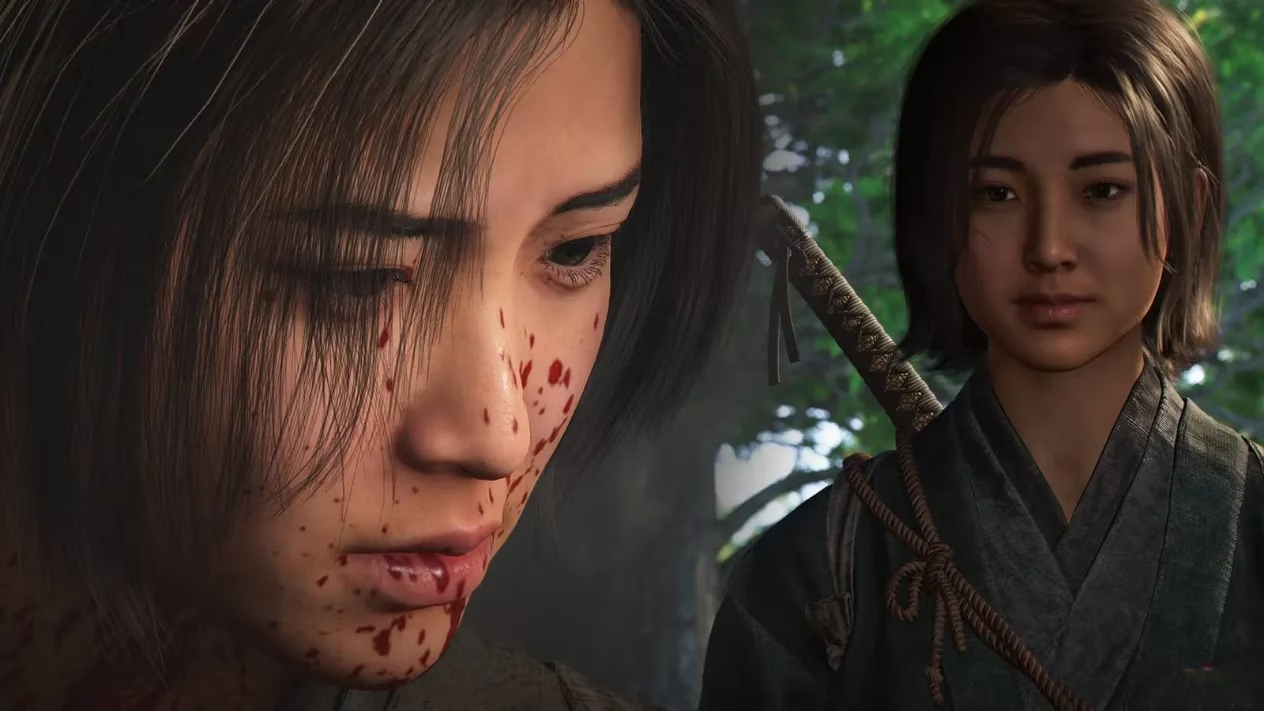
I respect confidence, but this was next-level squatting. I started to wonder if my dialogue choices were just an elaborate decoration, like those fake buttons on an office thermostat.
The Illusion of Choice in Action
It didn’t stop there. Several story beats ask whether to spare or kill certain targets. I love moral dilemmas. I want consequences, reputation changes, companions yelling at me, maybe a hidden ending. Instead, kill or spare, the narrative railroad kept chugging along like I’d said nothing at all. The same allies showed up, the same revenge plot progressed, and the same bad guys made the same bad decisions.
| My Big Decision | What I Imagined | What Actually Happened |
|---|---|---|
| Refuse Junjiro | He leaves dramatically, I feel terrible | He moves in anyway, I look rude for one second |
| Spare an enemy | They help me later or betray me | They vanish into narrative fog |
| Kill a rival | A faction hunts me, I face consequences | The next quest is identical |
That table isn’t just a joke—it’s basically the entire game’s approach to player agency. You can push the buttons, but the ride doesn’t change direction.
Dialogue Options: Same Sandwich, Different Toothpick
Some players argue that tiny dialogue changes are enough. I get it—hardcore RPG fans can be satisfied by flavor text. But if I choose “I trust you” versus “you’re lying,” I expect at least a different facial expression or a locked door. In Assassin’s Creed Shadows, the outcome is often the same, which makes every conversation feel like one of those old “choose your own adventure” books where all roads lead to page 47.
The irony is sharp: this is supposed to be interactive storytelling, but the game keeps yanking authority away from me. I felt less like a shinobi shaping destiny and more like a tourist on a very scenic, very predetermined tour bus. The branching narrative promised by the marketing turned out to be a single branch with a few decorative leaves.
Canon Mode: The Game Admits the Truth
Then there’s Canon Mode. Ubisoft included a mode that removes choices entirely and just tells the intended story. Honestly, it’s the funniest admission in modern gaming: “We let you choose, but not really.” It’s like a restaurant offering a menu where every dish is chicken, and one option is just chicken with the menu hidden. Canon Mode removes the illusion and, weirdly, makes the experience more honest.
As of 2026, the game has settled into this weird space where I enjoy the parkour and stealth but stop expecting my decisions to branch anywhere meaningful. The open world is beautiful, the assassination gameplay is solid, and the hidden blade remains satisfying. But the dialogue trees feel bolted on, offering the appearance of choice without the substance of consequence.
What Could Have Made It Better?
I’m not asking for every dialogue option to spawn a new DLC. But meaningful choice requires three ingredients: visible consequence, lasting fallout, and a reason to replay. Maybe if sparing a target changed a later mission, or if companions reacted to my ruthlessness, the roleplay would feel real. Even small state changes—like a hideout upgrade, a unique weapon, a different final confrontation, or altered weather that reflects my choices—would go a long way.
Without those changes, the replay value suffers. Why would I start a second playthrough to see a different ending if the ending is the same no matter what I do? The illusion of choice doesn’t just break immersion; it quietly erases the reason many players engage with roleplaying systems in the first place.
Final Thoughts
Ultimately, Assassin’s Creed Shadows is a fun open-world stealth game wearing the costume of an RPG. The choices are there, but they’re mostly cosmetic. I’ll keep playing because feudal Japan is gorgeous and I love assassinating from rooftops. But next time, I might just turn on Canon Mode and let the game stop pretending I’m in charge. That way, when Junjiro moves in uninvited, at least I won’t be surprised.
As reported by Destructoid, player agency in big-budget open-world games often lives or dies on whether choices create tangible downstream consequences—something your Junjiro hideout “refusal” moment underscores by turning a dramatic decision into a cosmetic line of dialogue. Framing “kill or spare” options as meaningful while keeping missions and character states largely unchanged can make narrative systems feel like set dressing, and it’s why modes like Canon Mode can ironically feel more honest: they align expectations with a curated, linear story instead of implying branching outcomes that rarely materialize.