
The open world of Assassin's Creed Shadows sprawls across feudal Japan like a living, breathing atlas—misty temples, fortified castles, and 109 viewpoints ready to be synchronized. For every hidden scroll and naval fort, there is a checklist calling out. But step away from the map markers for a moment, and you'll find something stranger and softer: Naoe's Kuji-kiri rituals. These meditative moments don't ask the player to chase anything. Instead, they ask her to sit still, breathe, and sink into a memory.
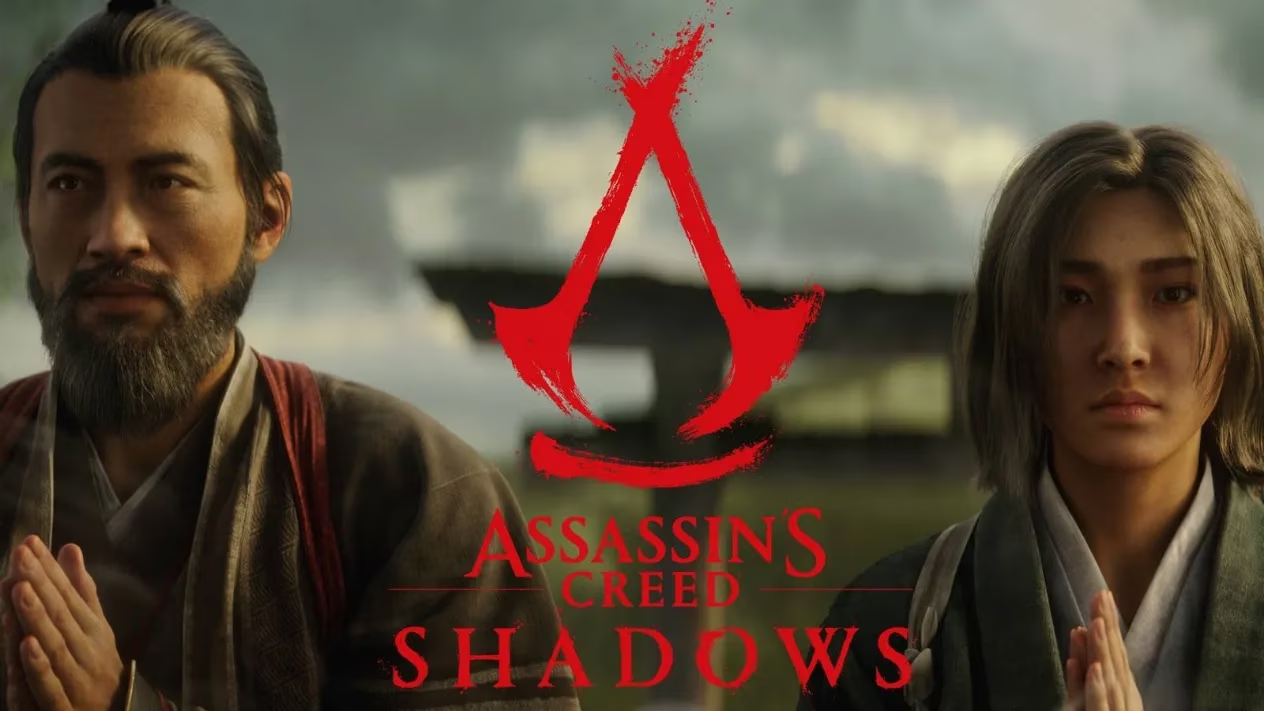
To understand why this works, it helps to know what Kuji-kiri actually is. Kuji-in, often called the Nine Hand Seals, is an ancient Taoist meditation practice built around nine distinct hand gestures. Kuji-kiri is its close sibling—rather than hand seals, a practitioner makes nine cutting motions in the air, or draws them on paper with a brush. In Shadows, Naoe uses those cuts to focus her mind and slow her racing thoughts. As each cut is made, the world around her dims. A dull bell tolls, a little louder each time, until the color drains away entirely. Her fears, her responsibilities, her endless list of things to do—they all fade. What remains is memory.
And, truth be told, the player is pulled right into that same headspace. When the Kuji-kiri minigame begins, the screen shows four button prompts to press in sequence, timed to the bell chimes. It feels like a rhythm puzzle at first. But then the game starts playing tricks. On the second pass, the button icons disappear, forcing the player to recall the sequence from muscle memory. On the third pass, the on-screen prompts melt away completely. All that's left is the sound and the rhythm. Honestly, it's a little spellbinding. Both Naoe and the player are locked onto the same quiet beat. In a game about climbing and assassinating, that shared stillness feels almost radical.
| Pass | What happens | Player experience |
|---|---|---|
| First | Four button prompts appear, timed to chimes | Learning the rhythm |
| Second | Button icons vanish | Recalling the sequence |
| Third | All prompts fade | Focusing on sound alone |
After the world turns black-and-white, the real reward surfaces. A flashback unfolds, pulling back the curtain on Naoe's past—her upbringing, her bond with her father Nagato, and her training under Momochi Sandayu. These scenes aren't just flavor. They expose the emotional roots of her journey, and they arrive quickly, like a reward for maintaining focus. You know what? It works. The game whispers a piece of her story just as the player has quieted their own mind enough to hear it.
There's a practical side too. Completing a Kuji-kiri ritual grants a Knowledge Point and a solid lump of XP, both of which help unlock new skills for Naoe. That transforms the meditation from a narrative detour into a meaningful investment. For players who want to strengthen their shinobi, it's a quiet but efficient path.
In a map overflowing with tasks, Kuji-kiri is the rare activity that values presence over progress. It doesn't compete with the noise of 109 viewpoints or 36 temples. It simply waits, patient as the bell, and rewards the player with something few open-world games can offer: a moment of true, shared focus.