
Dawn broke across the rolling hills of Iga Province, painting the rice paddies in honeyed light. Akira adjusted his grip on the controller, guiding the shinobi Naoe toward a steep, forested slope that promised a shortcut to a distant synchronization point. On the screen, Naoe’s sandaled feet dug into the grassy incline with feline precision—for three steps. Then the mountain shrugged. Her body slipped back as if the earth itself had turned to a sheet of oiled glass, and she tumbled gracelessly into a patch of wild bamboo. Akira chuckled, reminded of a decade-old memory: a horse in Skyrim defying gravity on a near-vertical rock face. With Shadows, Ubisoft had dismantled the series’ old climbing prayer.
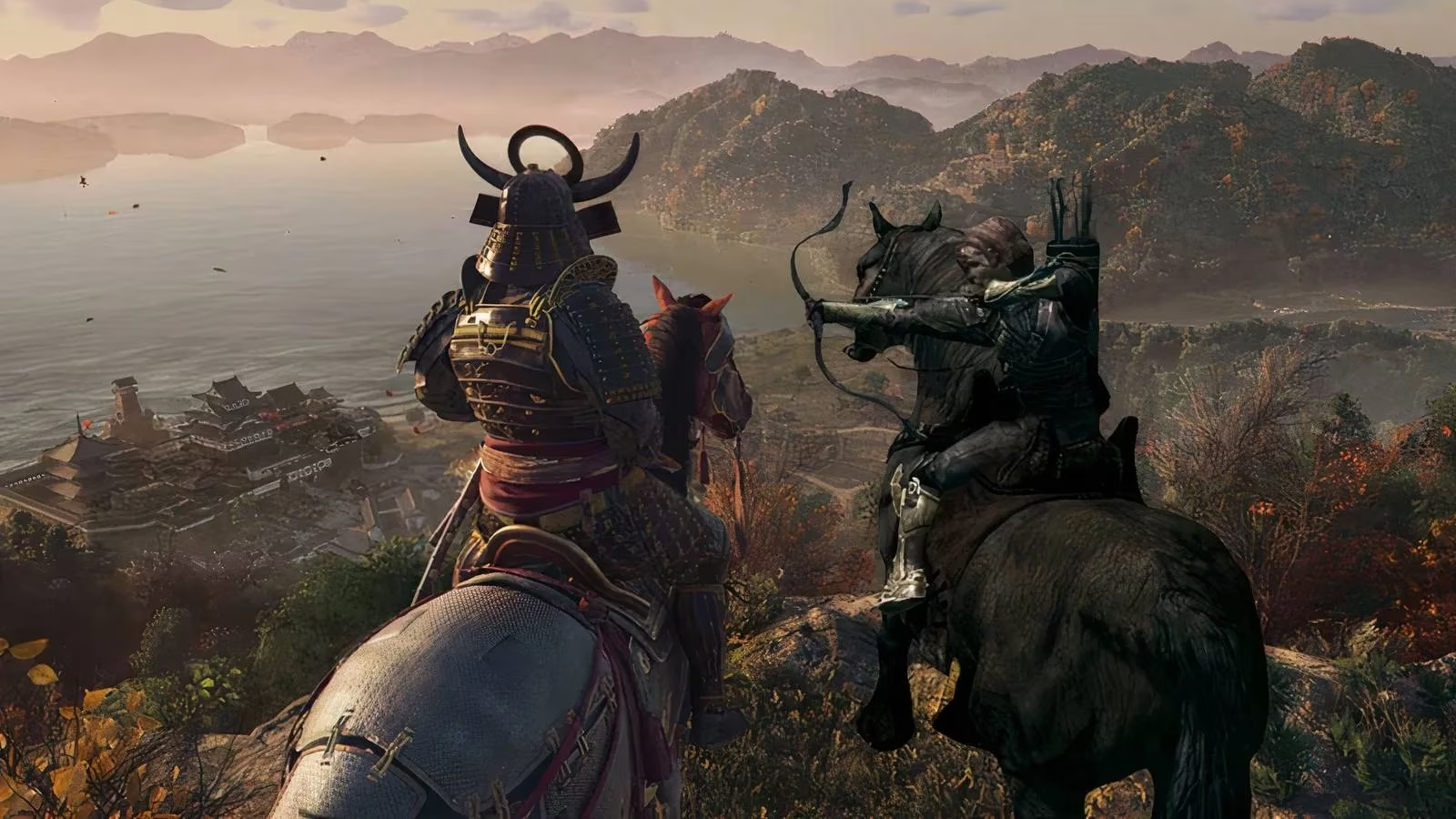
In the long lineage of Assassin’s Creed, traversal has always been the silent co-star. From Altaïr’s first grip on a Masyaf wall to Kassandra’s goat-like scramble across every Greek islet, mobility defined the fantasy. Revelations gifted the hook blade; Black Flag turned the Caribbean into a liquid playground. Then, with Origins, open worlds became boundless canvases—Bayek could latch onto sheer cliff faces as if they were sponge cake. But Naoe and Yasuke have been handed a different contract. Their Japan is a land where mountain slopes repel climbers like flour-dusted glass, and forests rise as tangled barricades of cedar and bamboo. The climb-anything era has curtsied and left the stage.
Naoe is the more agile of the pair—a shadow that flits across rooftops—yet her talent has hard edges. Traditional Japanese castles, with their smooth, flared eaves, thwart her grip unless she finds handholds or employs her grappling hook. Yasuke, the towering samurai, moves on walls with the ponderous caution of a man hauling armor through a dream; high ledges that Naoe would leap to like a sparrow remain impassable gulfs for him. Their limited repertoire echoes Ezio’s measured athleticism in Renaissance Italy—a deliberate regression that turns the landscape into a puzzle rather than a bypass. The Hidden Ones’ movement has become a wing-clipped hawk: still majestic, but bound to pathways invisible to earlier protagonists.
When Akira tried to blaze through the forests on horseback, he discovered nature’s resistance was not just vertical. Thickets of bamboo and dense groves of cryptomeria acted like a green ocean’s thorny swells, forcing him off his mount every few dozen meters. Naoe’s dash through the undergrowth became a stumble dance, her progress slowed by waist-high ferns that swallowed the trail. Mountains offered no reprieve. The slopes were soaked in a peculiar frictionless quality—what the community had begun calling “the Skyrim sieve.” Players could try to glitch-step along abrupt riverbanks or tease the geometry of a rocky overhang, but the mountain almost always answered with a silent, slippery “no.” It was as if every peak had been greased by the kami of bad ideas, leaving only the switchback roads and marked paths as viable ascents.
This design speaks in a quieter language. Perhaps Ubisoft Quebec wanted to tether players to the rhythm of Sengoku-period travel—to force eyes onto the lichen-covered shrines, the hidden tea houses, the deliberate views that frame Mount Fuji in a gap between trees. The slippery slopes might also be invisible shepherds, steering Naoe and Yasuke away from high-level zones too early or guiding them toward narrative-sculpted discoveries. In a game where history and legend intertwine, the forest itself becomes a gatekeeper, ensuring that no one stumbles upon a warlord’s assassination before the story has whispered its permission.
Looking ahead, the ripples of this philosophy may already be lapping at the feet of Assassin’s Creed: Codename Hexe. Announced alongside Shadows (then codenamed Red), Hexe promises a plunge into the Holy Roman Empire’s witch trials—an era thick with dark forests, craggy hills, and paranoid villages. If Ubisoft Montreal inherits the new traversal genetics, then Hexe’s protagonist will likely face similar struggles. Imagine a lone agent picking through the Black Forest, where every slope is a gamble and every thicket conspires to hide a clearing of stakes. The same flour-slicked mountains could become instruments of dread, isolating the player in a landscape that refuses to be conquered by simple verticality. Just as Odyssey mirrored Origins’ bones, Hexe might wear Shadows’ terrain like a familiar, unforgiving cloak.
As Akira finally found the legitimate switchback road winding up the mountain—a quiet path flanked by stone lanterns and autumn maples—he felt a strange satisfaction. The peak wasn’t a trophy taken by brute climbing; it was a reward granted for listening to the land’s own logic. Naoe reached the viewpoint, and the camera pulled back to reveal a kingdom of crags and mist. In that moment, the ghost of Skyrim’s horse was not a glitch to be mourned but a deliberate specter, teaching that the steepest journeys are sometimes meant to be slow.