
As I navigate the lush, detailed landscapes of Feudal Japan in Assassin's Creed Shadows, a familiar, jarring sight pulls me right out of the historical immersion: bright yellow paint splattered across ledges, crates, and ladders. I understand the developer's dilemma. In 2026, games are more visually complex and hyperrealistic than ever. Distinguishing interactive elements from static background art is a genuine challenge. It's a far cry from the days of Tomb Raider's miraculously lit corridors or Final Fantasy 9's loot that popped against painted backdrops. Creative director Jonathan Dumont's explanation to GamesRadar resonates—players in tests were struggling without guidance. Yet, accepting this solution feels like a concession, especially for this series. Yellow paint is such a boring, generic way to solve a problem that Assassin's Creed, of all franchises, has a built-in, elegant toolkit to address.
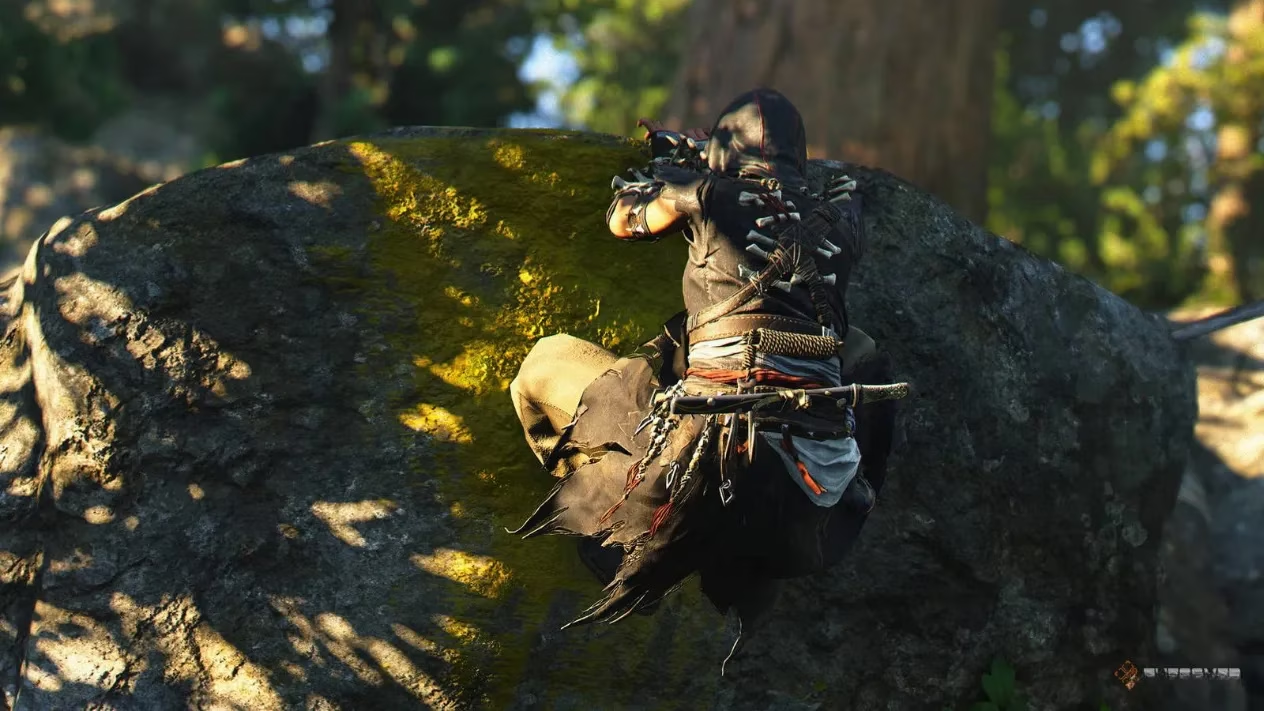
The Animus Is Right There!
The core issue, for me, isn't the need for guidance—it's the method. Unlike other historical action games, Assassin's Creed has never truly taken place in the past. We experience these worlds through the Animus, a simulation reconstructing genetic memories. This narrative framework has historically been a playground for inventive game design. Remember being funneled down a linear path by a 'desynchronization' warning? Or the distinct audio cue that marked every collectible scroll? The series has always immersed us in two layers: the historical setting and the Abstergo simulation matrix. This duality provides Ubisoft with a treasure trove of diegetic tools to guide players, tools that feel organic to the AC universe.
Seeing garish yellow paint mercilessly thrown across the beautiful Japanese landscape feels painfully video-game-y. It rips me out of the experience because it ignores the series' own identity. I'd much rather be guided by those striking, glitchy visual effects that are intrinsically Assassin's Creed—the same digital artifacts and sound effects that have been seared into our brains since 2007. The Animus isn't just a plot device; it's a design philosophy waiting to be fully utilized.

A Legacy of Inventive Guidance
Ubisoft's own history proves they can do better. They've solved this puzzle before with far more creativity. Let's look at some iconic examples:
-
The Lairs of Romulus (AC: Brotherhood): These hidden tombs weren't marked by yellow paint. They were integrated into the fabric of Rome, often hinted at through architectural clues, eagle vision, and a sense of secret history. Finding them felt like a discovery, not following a neon sign.
-
Ancient Tombs (AC: Origins): The tombs beneath Egypt's pyramids used environmental storytelling, subtle lighting, and Bayek's eagle, Senu, to guide exploration. The paths felt mysterious and ancient, not explicitly flagged for a tourist.
-
Leap of Faith Points: The classic synchronization points are the ultimate example. A towering viewpoint, a climbable structure—their visual prominence in the world design naturally draws the eye. The guiding principle is world design, not world painting.
In Shadows, the yellow paint is reportedly reserved for hidden trails, which are seamlessly woven into the environment. I appreciate that these paths would be harder to spot. But that's precisely where an Animus-based solution could shine! Imagine:
-
A faint, digital ripple effect along climbable surfaces when Eagle Vision is active.
-
Subtle, ghostly echoes of a previous ancestor taking the same path.
-
A low, resonant hum from the "simulation" that grows louder near traversal points.
-
Temporary, glitchy highlights that appear only when you're actively looking for a path, triggered by a button press or a skill.
Any of these would feel more at home in the AC universe than industrial safety paint.
The Cost of Generic Design
My disappointment stems from a sense of lost potential. Assassin's Creed once stood out. Its unique matrix setting gave it a distinct edge over other historical games. It had a language of its own. Now, when I see those yellow-marked parkour routes in Shadows, they are visually indistinguishable from segments in Final Fantasy VII Rebirth, Horizon Forbidden West, or countless other open-world games. The series has, in this one specific aspect, surrendered to a homogenizing trope.
This isn't just about aesthetics; it's about cohesion. The magic of Assassin's Creed has always been the delicate balance between historical fantasy and sci-fi simulation. Yellow paint shatters that balance. It reminds me I'm playing a video game in the most mundane way possible, while a flickering Animus glitch would remind me I'm inside a specific, beloved type of video game world.
I know Ubisoft can do better. The entire legacy of the series shows as much. To see them give in to such a generic solution, especially in a game set in a locale as breathtaking and anticipated as Feudal Japan, feels like a shame. If any studio had the narrative justification and creative history to find a brilliant, in-universe answer to the "yellow paint problem," it should have been them. For now, navigating Japan in Shadows is a breathtaking experience, but one occasionally marred by a splash of generic, out-of-place color that whispers of missed opportunities. 🎮⚔️🗾